
Equities
Brinson-Fachler
Allocation · Equity Selection · Interaction
Privately Deployed AI for Asset Managers and Asset Owners
Illuminate where alpha is created, lost, and left on the table.
Measure what the research actually contributed
ZTA measures analyst paper-portfolio performance against approved benchmarks and compares it to actual portfolio outcomes.
Illustrative figures, not client results
The paper portfolio holds every recommendation, thesis, and committee decision — including the ideas that never left the page. Positions are read directly from your OMS, so nothing is added to the PM’s workflow. Implementation shortfall then separates what the research was worth from what the implementation returned, closing the loop between research and results.
Common metrics aggregate. Methodology-specific attribution effects stay separate — Brinson-Fachler for equities, Campisi for fixed income — with Apis, ZTA’s governed AI research assistant, explaining what drove the result.
Allocation · Equity Selection · Interaction
Income · Treasury · Spread · Fixed Income Selection
From research to decision
ZTA connects research, model analysis, Human Judgment, recommendation management, and outcomes into one governed workflow.
Does recent financial and operating evidence warrant changing the internal credit view from Stable to Deteriorating?
Evidence set: 14 approved sources.
Evidence supports a cautious view but stops short of a rating change.
Greater weight to deteriorating liquidity and covenant headroom, with a clearer downside-first framing.
Evaluator recommendation. Strong on evidence coverage, less aligned to the firm’s risk posture.
Underweights the change in operating flexibility and overstates the stabilizing factors.
Model Assurance | Evidence-Led Qualification
ZTA Labs delivers Continuous AI Assurance through two complementary disciplines. Model Assurance evaluates individual models for accuracy, reliability, evidence fidelity, and operational suitability. Council Assurance tests the collective system for independent challenge, meaningful disagreement, evaluator reliability, and governance integrity. Together, they provide the evidence needed for qualification, ongoing monitoring, and informed Human Judgment.
Open-Weight Model Ecosystem
United States


Canada

France

UAE

China





Evaluate candidate models against a governed, client-specific calibration corpus. Test answer quality, execution reliability, evidence fidelity, evaluator integrity, and the independent contributions models make to the Model Council.
Re-evaluate approved and candidate models as versions, runtimes, configurations, and institutional requirements change. Test evaluator stability, detect performance regressions, reassess Council contribution, and incorporate recorded Human Judgment and outcomes where available to guide governance recommendations.
Sample Model Assurance Baseline
A governed model assessment with model-level findings, failure analysis, source-level auditability, governance requirements, and deployment recommendations.
In a historical ZTA Labs Council assessment, a model with no unique best-answer wins was reported to have broken false unanimity three times. The finding illustrates why Council Assurance examines independent challenge and model complementarity rather than relying solely on average benchmark rankings.
Historical research observation; not a current Council qualification or a measured human-decision outcome. Reported in the September 2026 ZTA Labs research compilation. The underlying seat-contribution calculation was not retained, so the count has not been independently reproduced.
Historical testing identified a contradiction between a benchmark answer key and its evaluation policy.
After the policy was corrected, the candidates still failed because their answers omitted material information disclosed in the source evidence.
Historical research observation from a September 2026 assessment. Not a current model qualification and not a production readiness result.
Why the architecture has to change
Asset managers are adopting AI across research and investment workflows. When model providers, governance controls, and decision records remain disconnected, institutions can lose visibility into how Human Judgment informs consequential decisions.
Proprietary research and institutional context can cross organizational boundaries as AI usage expands.
Model output is often difficult to reproduce, challenge, and trace back to the evidence and controls that shaped it.
AI-generated knowledge can remain trapped inside tools instead of becoming durable institutional intelligence.
Reliance on external providers can constrain flexibility, while changes in models, runtimes, and institutional requirements create a continuing need for evaluation.
Built for extension
ZTA provides the governed core. Your team builds the dashboards, agents, workflows, connectors, and applications that make it yours.
Your team builds
Institution-specific experiences and intelligence
Consume governed ZTA data through APIs
Build firm-specific intelligence
Encode the way your investment process works
Integrate institutional and external systems
Build experiences beyond the ZTA UI
Published extension layer
Stable, secure interfaces for building on ZTA
Query and retrieve governed data
Build agents and tools
Real-time updates and webhooks
Integrate your systems and data
Extend governance within your workflows
ZTA governed core
Model-agnostic and built for the institution
Who can access what
What intelligence may do
Approved, replaceable models
Provenance and traceability
From evidence to judgment to decision
Research to portfolio to return
Your IP above the line. ZTA governance below it.
Built on Open Source





Built on measurable controls
ZTA Labs is built around documented, versioned methodologies rather than vendor assertions or opaque AI scoring.
Models are tested against institutional workflows, not only generic benchmarks.
ZTA tests the instrument used to judge models, not just the models themselves.
Model Assurance, attribution, and governance methodologies are designed to remain documented and auditable.
The architecture is designed to record what investment professionals decide, their reasoning, and the evidence supporting those decisions.
The architecture is designed to preserve traceability across evidence, model outputs, policies, Human Judgment, PM disposition, and recorded outcomes.
A practical path to production
ZTA Labs engagements are designed to move from a bounded first workflow to a production environment with clear scope, timing, and commercial expectations.
Path 1
Prove the full architecture on your data and workflows.
Path 2
Benchmark models and establish a baseline.
Optional Standalone Model Assurance is available independently or alongside a ZTA Architecture trial.
Define scope, objectives, and success criteria.
30–60 minutesOne-week ZTA Architecture Trial on your data.
1 weekProduction architecture, data, models, governance and integrations.
2–4 weeksImplement and validate the first governed workflow.
6–12 weeksIn production inside your environment.
OngoingReassess models, Council contribution, evidence, and drift.
Every quarterClear scope and commercial terms before deployment begins.
Pricing depends on workflows, data sources, models, integrations, and governance requirements.
Scale through evidence and institutional approval.
The Buzz · ZTA Labs Research
Research and perspectives on models, architecture, governance, AI economics, Investment Research, and institutional intelligence.
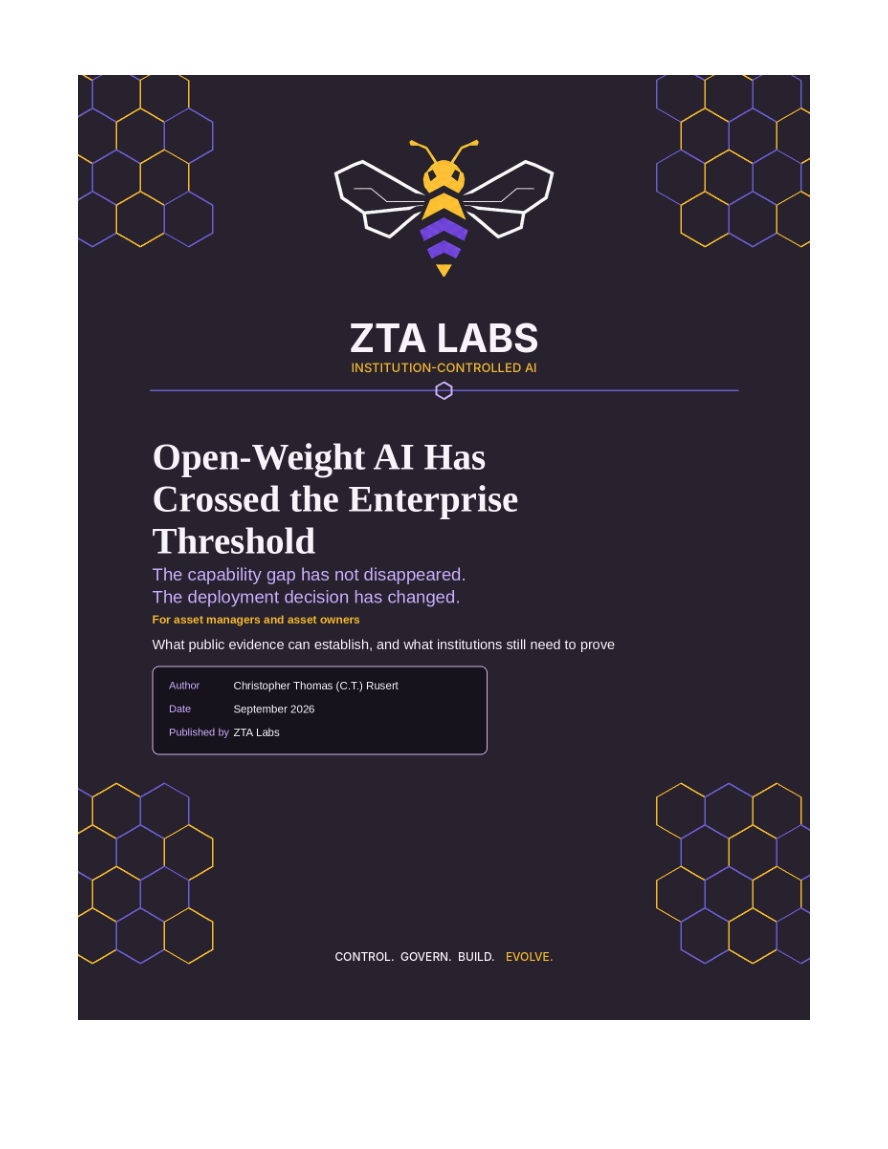
The capability gap has not disappeared. The deployment decision has changed.
Public evidence shows that open-weight AI has become a credible enterprise architecture option. But leaderboard performance cannot establish whether a model is fit for an institution’s work.
Earlier: The Seven Steps to AI Independence →
Start with one workflow
Define a specific investment workflow, data boundary, and governance requirement. ZTA Labs will help determine the right first step—Architecture Trial, Model Assurance, or both.